Diagnose Kafka Consumer Lag and a Stuck Partition
Compare committed offsets with partition ends, inspect group members and assignments, and examine the records around a stuck position before changing offsets.
Read the guide →Bug Days field guides
Short on theory, long on recognizable evidence. These guides explain what to inspect, why it matters, which mistakes waste time, and how to move from raw diagnostic material to a defensible answer.
Subscribe with RSS
Compare committed offsets with partition ends, inspect group members and assignments, and examine the records around a stuck position before changing offsets.
Read the guide →
Read an exact Kafka offset range or start at a UTC timestamp, inspect key and headers, and understand retention and compaction gaps.
Read the guide →
Copy a Kafka record or bounded offset range to the same or another cluster, preserving key, value, headers, and partition order where possible.
Read the guide →
Inspect the certificate chain a live HTTPS, Kafka SSL, LDAPS, SMTPS, IMAPS, or raw TLS service presents; diagnose expiry, SAN mismatch, SNI, trust, and missing intermediates.
Read the guide →
Check A, AAAA, CNAME, MX, TXT, NS, SOA, SRV, CAA, and PTR records; understand split-horizon DNS and forward-confirm a reverse DNS hostname.
Read the guide →
Learn what an IP address lookup can reveal about an ISP, ASN, network owner, approximate location, reverse DNS, and cloud provider—and what it cannot prove.
Read the guide →
Investigate access-log IPs against cloud provider feeds, hosting ASN prefixes, CDN networks, and published crawler ranges without mistaking infrastructure for intent.
Read the guide →
A practical gRPC testing workflow: load a proto contract, choose a method, build protobuf data from JSON, send metadata, inspect trailers, and debug status codes.
Read the guide →
Choose the correct browser transport for a gRPC service, understand when gRPC-Web works directly, and test native HTTP/2 gRPC through a local bridge.
Read the guide →
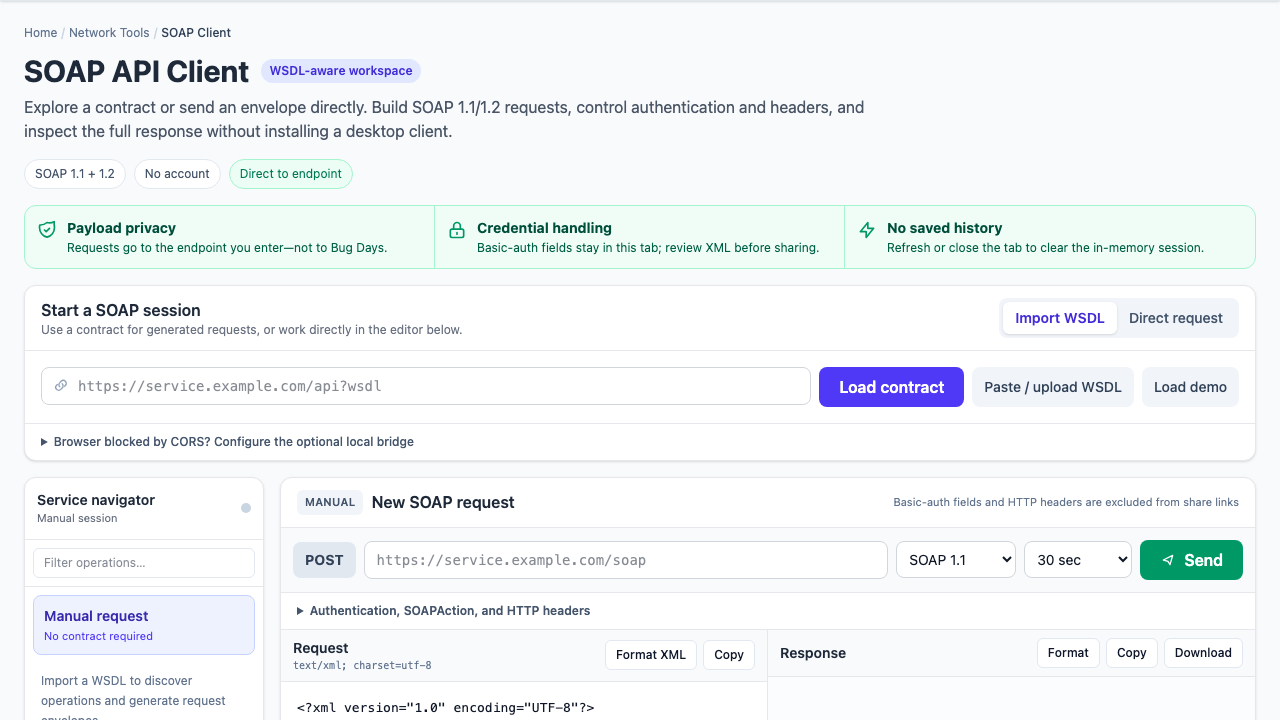
Identify which SOAP authentication layer a service expects, test HTTP credentials safely, recognize WS-Security headers, and separate mTLS failures from SOAP faults.
Read the guide →
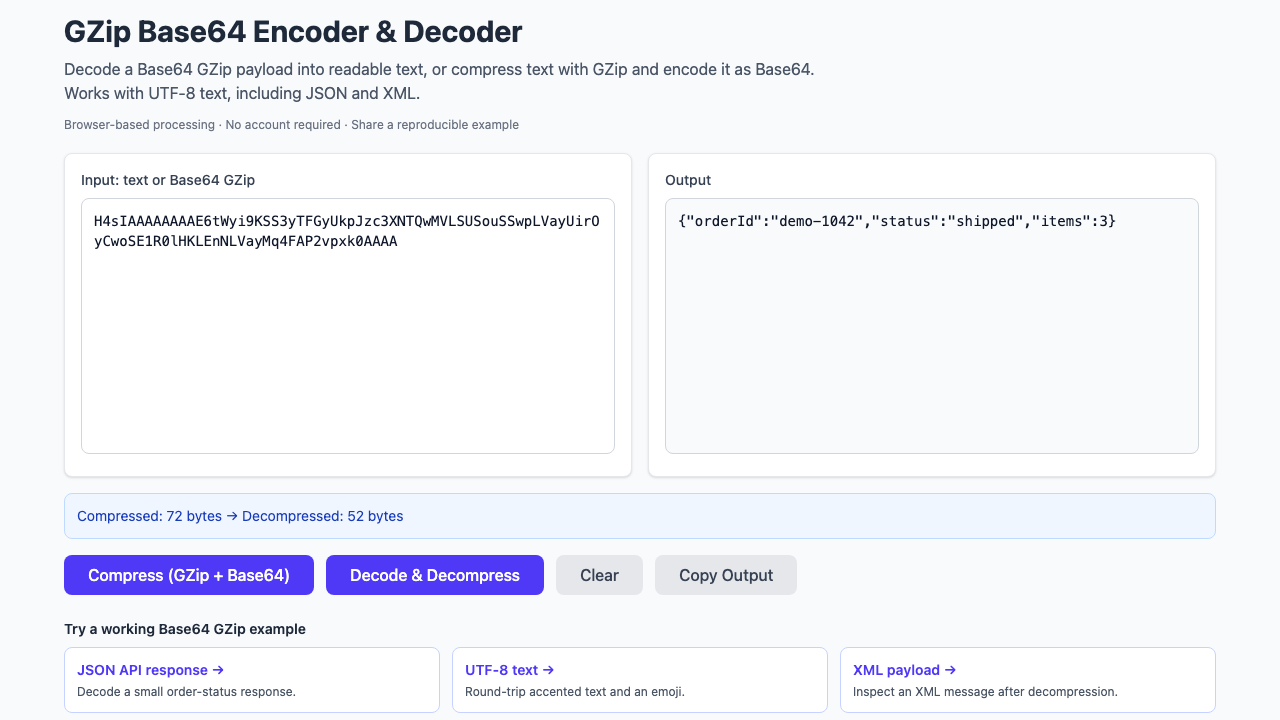
Decode a Base64 GZip string into readable JSON, understand the H4sI prefix, and share a working example that opens directly in the browser tool.
Read the guide →
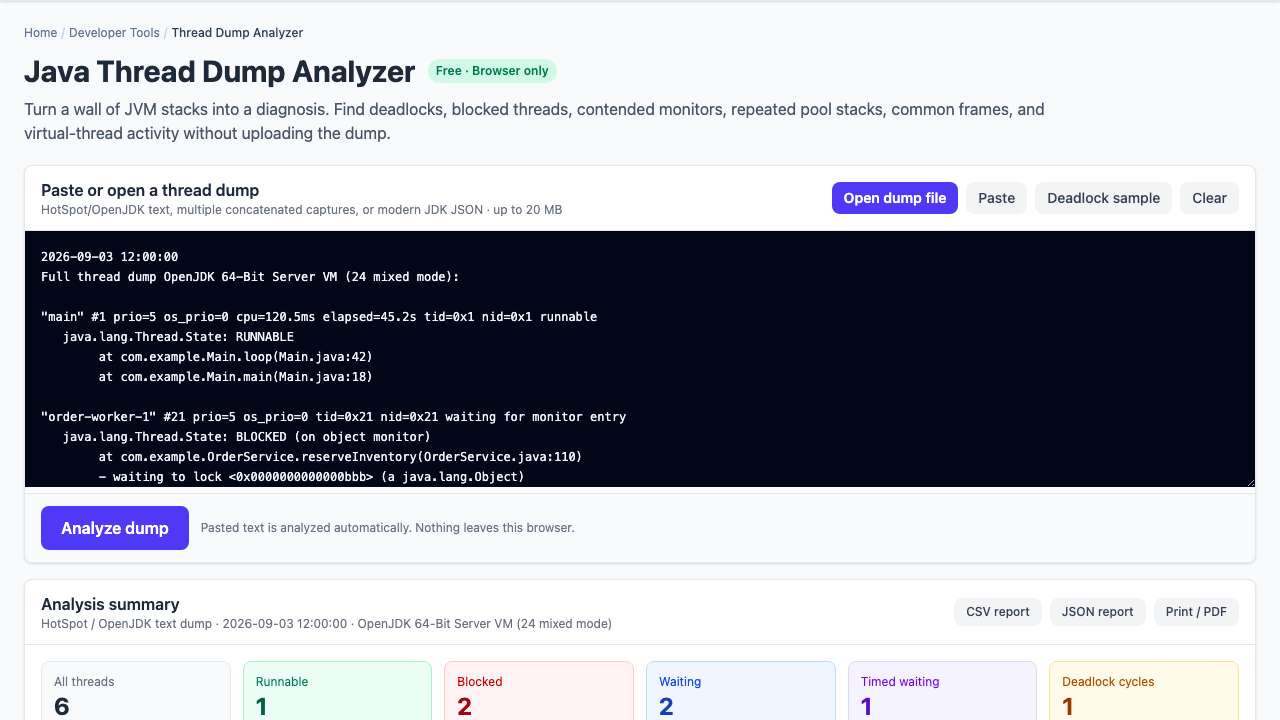
A practical, evidence-first method for reading jstack and jcmd output, tracing monitor ownership, confirming deadlocks, and separating ordinary waits from incidents.
Read the guide →
Identify common X.509 certificate formats, inspect their contents, convert them safely with OpenSSL, and avoid confusing filename extensions with encodings.
Read the guide →
Turn a WSDL operation into a working request, choose the right SOAP version and headers, interpret faults, and recognize browser CORS limitations.
Read the guide →
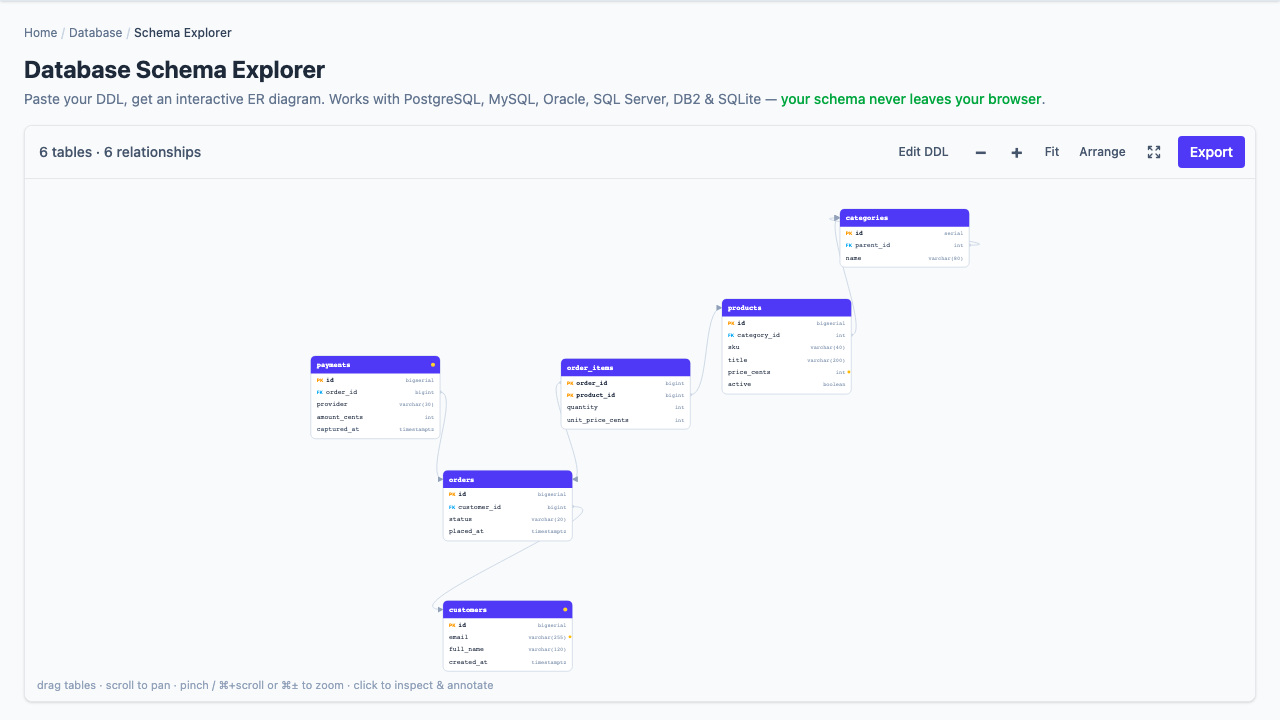
Extract a schema-only database definition, visualize foreign-key relationships, add useful annotations, and export documentation without connecting another service.
Read the guide →
Turn ASCII pipes, Unicode box drawing, PostgreSQL results, or aligned console output into editable Excel, CSV, HTML, Word, and printable tables.
Read the guide →
Compress UTF-8 text to Base64 GZip in Python and Node.js, decode it across languages, and compare the results with a runnable browser example.
Read the guide →
Diagnose invalid Base64, incorrect GZip headers, truncated payloads, and unreadable output. Compare your input with a working, shareable example.
Read the guide →